When ‘Flat Out’ Becomes ‘Normal’

How to tell when busy has become too much, and what to do about it

When the pace builds gradually, you adapt to it. Long hours and a full head start to feel like the way things are, and you’re often the last to notice how much you are carrying.

In this live three-hour workshop, Ian McDermott and Professor Patricia Riddell bring together neuroscience and decades of coaching experience to help you see where you are right now, spot your own warning signs, and leave with one practical change to carry into year end, and beyond.

“Is the pace I’m working at normal, or am I just used to it?”

Paid Workshop · 18th November · 2pm–5pm UK · 3 hours · Live & Online

£125+VAT

With Ian McDermott and Professor Patricia Riddell

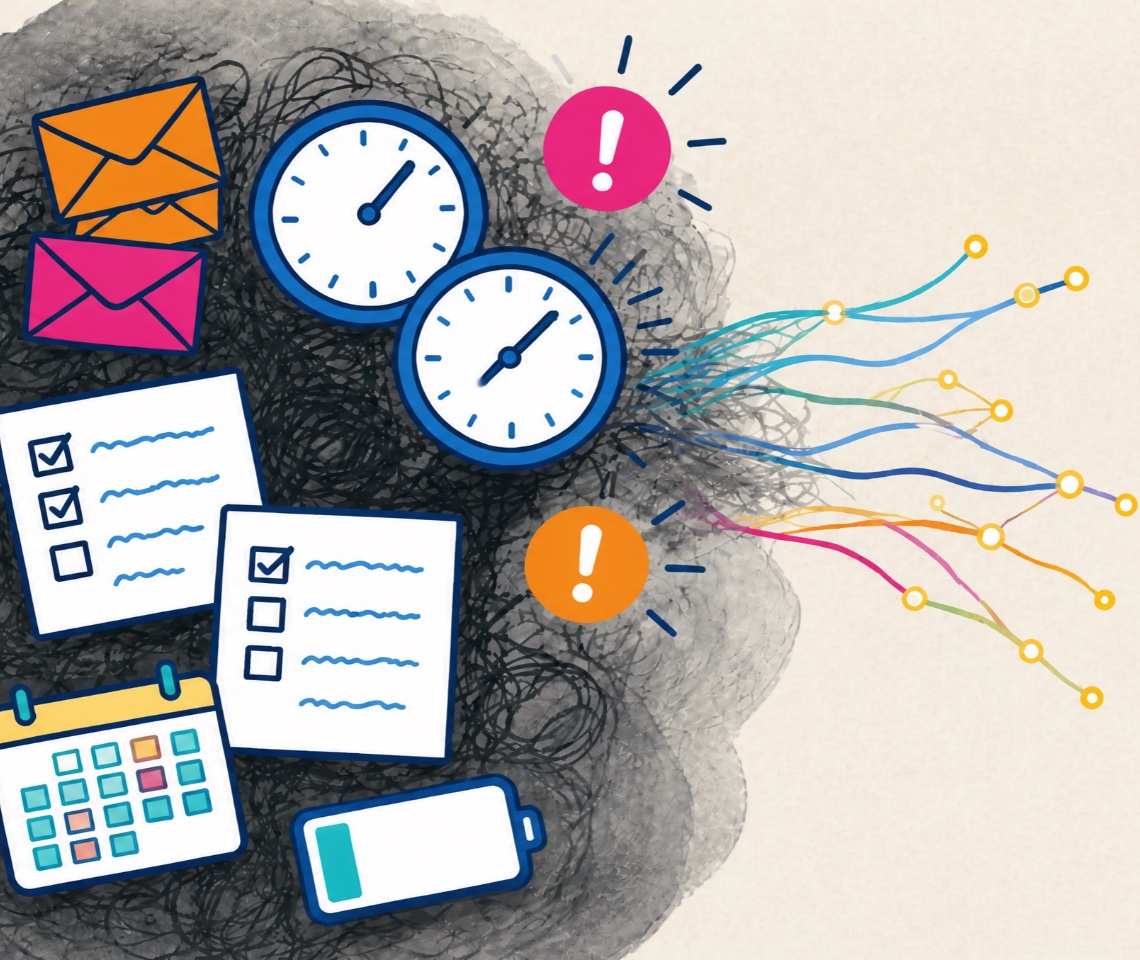
Illustration of emails, clocks, to-do lists and a low battery tangled in a dark scribble, with colourful threads untangling to the right
This is a practical, interactive session. You’ll step away from the day-to-day, look at your own situation properly and try out new approaches with expert input, alongside people who recognise the same pattern in their own lives.
Three hours, liveBacked by neuroscienceOne change that sticks

What you will gain

  • Where you are now — A picture of where you are right now, and how your sense of “normal” has drifted
  • Challenge or overload? — The ability to tell the difference between appropriate and unsustainable challenge
  • Your early warning signs — A clearer sense of your own warning signs, before “I can cope” results in overwhelm or even breakdown
  • Source, not symptoms — A way of looking beyond the symptoms of stress to the underlying causes, so you can choose what to do differently
  • Working with your brain — An understanding of why change is hard for the brain, and how to work with that rather than against it
  • A plan that lasts — One practical change to carry into year end and beyond, and a way to make it stick
  • Permission to refuel — Confidence that putting your own oxygen mask on first isn’t selfish, but the key to contributing more to others

Is this workshop for you?

Have you ever asked yourself:

  • Is the pace at which I am working normal, or am I just used to it?
  • How do I tell when stress is helping me be at my best, and when it’s too much?
  • Am I dealing with the symptoms or the source of my stress?
  • I know what I should change but I don’t seem to be able to make it happen. What do I need to do differently?
  • How do I get through December without becoming so run down I am ill at Christmas?
  • I feel bad if I stop to look after myself. Am I being really selfish?

If so, this workshop will help you find the answers.

Three hours. Two expert guides. One practical change to carry into year end, and beyond.

Ian McDermott

Your workshop leaders

Ian McDermott

Founder of ITS · Trainer & Coach

Ian McDermott has dedicated his life to giving people the tools to deal with the challenges they face and the skills to create their own solutions. He is renowned for making learning simple and enjoyable, for rekindling people’s curiosity and confidence, and for a teaching style that helps people feel more at ease in themselves and the roles they find themselves in.

Ian is the founder of International Teaching Seminars (ITS) and a leadership, innovation and collaboration consultant. He has trained a generation of NLP Practitioners, NLP Master Practitioners and Coaches working all over the world. His 15 books have been translated into more than 20 languages.

Professor Patricia Riddell

Your workshop leaders

Professor Patricia Riddell

Professor of Applied Neuroscience · Chartered Psychologist

Patricia Riddell is Professor of Applied Neuroscience in the School of Psychology and Clinical Language Sciences at the University of Reading, and a Chartered Psychologist. She teaches on the MBA, the MA in Leadership and the MSc in Coaching and Behavioural Change at Henley Business School.

Her work focuses on how neuroscience can be applied in the real world to deepen our understanding of coaching, leadership, behavioural change and resilience. She is co-author of The Neuroscience of Leadership Coaching and has written widely on the neuroscience of coaching, bringing the evidence behind behavioural change to the people who put it into practice.

What others say

I am learning to create space between stimulus and response instead of reacting automatically.

Sally

The programme taught me to stop trying to have all the answers and give space for them to come to me.

Michelle

I feel lighter, more assured and more able to trust myself.

Bethan

I realised I can create a future that feels exciting rather than overwhelming.

Ashley

I realised I can create a future that feels exciting rather than overwhelming.

Ashley

I realised I can create a future that feels exciting rather than overwhelming.

Ashley

New to ITS?

You’re very welcome. There’s no preparation to do and no prior knowledge of neuroscience needed. The workshop is interactive, with time to reflect on your own situation and talk ideas through in small groups, and you only share as much as you’re comfortable with.

The basics

Wednesday 18th November 2026, 2pm UK
3 hours
Live online via Zoom
£125 + VAT (£150 including VAT)
Anyone whose “busy” has become the default setting: leaders, managers, professionals and people juggling work and home. No prior knowledge of neuroscience needed.

FAQ

What will I gain from the workshop?
  • A picture of where you are right now, and how your sense of “normal” has drifted
  • The ability to tell the difference between appropriate and unsustainable challenge
  • A clearer sense of your own warning signs, before “I can cope” results in overwhelm
  • A way of looking beyond the symptoms of stress to the underlying causes
  • An understanding of why change is hard for the brain, and how to work with that
  • One practical change to carry into year end and beyond, and a way to make it stick

Most of us already have some idea of what we should change to feel less stressed. But doing it is another matter. When the pace builds gradually, you adapt to it, and you’re often the last to notice how much stress you’re carrying. Three hours with Ian McDermott and Professor Patricia Riddell gives you time away from the day-to-day to look at your own situation properly, try out new approaches, and get expert input. Hearing from others in a similar position often helps too, because it’s easier to spot the pattern in someone else first.

No. The workshop builds on some of the same ideas, so it’s a natural next step if you joined the free session on 2nd November, and it works equally well on its own.

Yes. Everyone who registers will receive the recording for a limited time afterwards.

You can have a 90% refund if you cancel up to 48 hours before the workshop. We’re unable to offer refunds after that, but if your plans change please let us know as soon as possible and we’ll do our best to help. All registered attendees will receive access to the recording.

Yes, please do! Coming with colleagues means you can compare notes, agree what you want to change together, and support each other in making it stick. Each person books their own place and will receive a VAT receipt by email once their booking is confirmed.

If you want to go deeper, Brain & Behavioural Change is ITS’s certified programme in applied neuroscience, starting in March 2027.

Three hours. A clear picture of where you are. One practical change to carry into year end, and beyond.

Wednesday 18th November 2026 · 2pm–5pm UK · 3 hours
Live online via Zoom with Ian McDermott and Professor Patricia Riddell · £125 + VAT